Three-Hare Motif (The Eternal Circle)
Regular price
$22.00

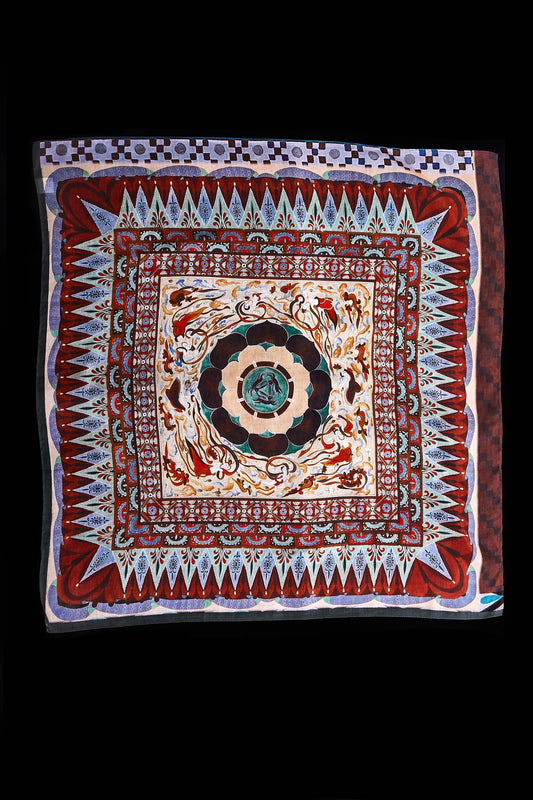
The Dunhuang "Three Hares Sharing Ears" motif, with its ingenious design of three hares chasing one another in a circle while sharing only three ears among them, stands as a luminous and enigmatic symbol in the history of global cultural exchange. First appearing in the caisson ceilings of the Mogao Caves during the Sui and Tang dynasties, its core meaning is deeply rooted in Eastern philosophy: the hares' pursuit symbolizes the cosmic principle of the cycle of rebirth and karma (corresponding to the "Three Periods of Time: past, present, and future"), while their shared ears embody the profound wisdom of harmonious coexistence and unity in essence (reflecting the "Three Bodies of the Buddha" united in the one "Dharma Body").
Astonishingly, this mysterious Eastern symbol embarked on a millennium-spanning journey across continents via the ancient Silk Road. It appeared on a 13th-century Iranian brass tray from the Mongol Empire and was later painted onto wooden ceilings and stained-glass windows in 15th-century German churches, such as the renowned Paderborn Cathedral. As it traveled, different civilizations infused the motif with local interpretations: in the Christian world, it resonated with the theological concept of the Holy Trinity ("Father, Son, and Holy Spirit"); in secular society, it commonly represented prosperity, harmony, and good fortune.
Thus, the "Three Hares" motif long ago transcended its original artistic form. It is not merely a treasure of Dunhuang murals but a global symbol that crosses religious and cultural boundaries. From the Buddhist Dharmakaya, Sambhogakaya, and Nirmanakaya (Three Bodies of the Buddha), to the Christian Father, Son, and Holy Spirit, and further to the past, present, and future that span time itself, diverse civilizations have all explored the ultimate unity of the cosmos and the divine through the concept of "three." This motif stands as a common artistic crystallization of this universal spiritual pursuit, bearing vivid witness to the interconnectedness and shared yearnings of humanity's spiritual journey.