
Three Hares: A Mysterious Chinese Motif That Traveled from Dunhuang to the World
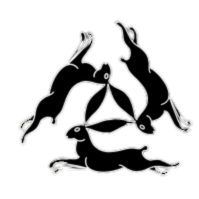
The Three Hares is an ancient motif depicting three rabbits chasing one another in a circular motion while sharing only three ears. At first glance, it appears to be a clever visual puzzle. Yet over the past 1,500 years, this image has traveled far beyond its place of origin in Dunhuang, China, spreading along the Silk Road to Central Asia, Iran, Egypt, and eventually into medieval churches across Europe.
Today, the Three Hares motif can be found in Buddhist caves, Christian churches, Islamic art, and Jewish cultural contexts. In the history of global art, very few motifs of Chinese origin have been so widely adopted, repeatedly reinterpreted, and integrated into different belief systems across civilizations.
What Is the Three Hares Motif?
The Three Hares motif—also known as San Tu Gong Er (三兔共耳) or Three Hares in English—is a classic example of a circular decorative design.
Its defining characteristics include:
Three rabbits arranged in a circular, running formation
Each rabbit appears to have only one ear
The entire image contains exactly three ears, shared among all three rabbits
This structure creates a continuous and stable visual loop. The image can be understood either as three individual rabbits or as a single unified entity with three forms. Because of this ambiguity, the motif lends itself easily to symbolic interpretation within religious and philosophical systems around the world.
Where Did the Three Hares Originate?
Based on currently available archaeological evidence, the earliest known origin of the Three Hares motif can be traced to the Mogao Caves in Dunhuang, China.
Among the surviving murals at the Mogao Caves, at least 17 caves feature depictions of the Three Hares on ceilings or central panels. The most representative examples include:
Cave 407 (Sui dynasty, approximately 6th century CE)
Cave 139
Cave 205
Cave 407 is widely regarded as the earliest and most securely dated example of the Three Hares motif in the world. These images are typically placed at the visual center of cave ceilings, indicating that they carried symbolic and spiritual significance rather than serving as mere decoration.
How Did the Three Hares Spread Along the Silk Road?
The Three Hares motif did not remain confined to China. Through the spread of Buddhism, long-distance trade, and cultural exchange, it gradually moved westward along the Silk Road.
Its transmission can be roughly outlined as follows:
6th century: Dunhuang, China (mature form within Buddhist art)
Around the 10th century: Guge Kingdom in Tibet and regions of Egypt
13th century: Islamic art in Iran and Central Asia
14th–15th centuries: Germany, France, and England
In southwestern England, particularly in Devon and the Dartmoor region, multiple medieval churches still preserve stone or wooden carvings of the Three Hares, most dating to the 15th century. This geographic pattern strongly suggests that the motif was introduced from abroad and later reinterpreted within European religious contexts, rather than originating locally.
Meanings of the Three Hares in Different Religions
The Three Hares motif was able to cross cultural and religious boundaries largely because of the openness of its symbolic structure.
The Three Hares in Buddhism
In Buddhist art, the Three Hares are commonly interpreted as representing:
The three times: past, present, and future
Cycles of cause and effect, life and death
The principle of continuous rebirth and renewal
This interpretation aligns closely with the Buddhist understanding of cyclical time and existence.
The Three Hares in Christianity
In medieval European churches, the Three Hares were often associated with:
The Holy Trinity: Father, Son, and Holy Spirit
Unity, eternity, and divine order
As a result, the motif could be seamlessly incorporated into church ceilings, roof bosses, and stained-glass windows.
The Three Hares in Islamic and Jewish Contexts
In Central Asia and Iran, rabbits were frequently regarded as symbols of:
Intelligence and alertness
Protection from evil and the attraction of good fortune
Accordingly, the Three Hares motif also appears on metalwork, amulets, and decorative objects within Islamic and Jewish cultural traditions.
Why Is the Rabbit Central to the Three Hares Motif?
Rabbits are among the few animals that carry remarkably consistent symbolic meanings in both Eastern and Western cultures.
Their shared associations include:
Exceptional fertility, symbolizing vitality, reproduction, and renewal
A connection to the moon, symbolizing cycles, time, and recurrence
In East Asia, rabbits are linked to lunar imagery such as the Moon Rabbit or Jade Rabbit. In the West, the rabbit is associated with spring, rebirth, and the Easter tradition. These shared meanings make the rabbit an ideal cross-cultural symbolic carrier.
The Three Hares and Chinese Philosophy
In Chinese philosophy, the number three holds fundamental significance.
The Dao De Jing states:
“The Dao gives birth to One;
One gives birth to Two;
Two gives birth to Three;
Three gives birth to all things.”
The Three Hares visually embody this principle by presenting:
Independent individual forms
A highly unified structural system
A continuous cycle that remains stable and unbroken
From this perspective, the Three Hares are not merely a religious symbol, but a philosophical visualization of wholeness, order, and generative process.
Frequently Asked Questions (FAQ)
Did the Three Hares definitely originate in China?
Based on current archaeological evidence, the Three Hares murals at the Mogao Caves in Dunhuang represent the earliest and most securely dated examples, making China the most widely accepted place of origin.
Why do Three Hares appear in European churches?
The motif likely traveled to Europe via the Silk Road and was subsequently reinterpreted within a Christian framework, particularly as a symbol of the Holy Trinity.
Why do the Three Hares have only three ears?
The shared-ear structure creates a visual loop that symbolizes unity, continuity, and an integrated whole.
What is the relationship between the Three Hares and Buddhism?
In Buddhist art, the motif often represents the three times and the cycle of cause and effect, which explains its frequent placement at the center of cave ceilings.
Conclusion
The Three Hares is not a symbol belonging to any single religion or civilization. Rather, it is a form of visual philosophy that can be understood across cultures.
Originating in Dunhuang and traveling across continents, the motif has quietly endured for more than a millennium, appearing beneath the domes and ceilings of vastly different traditions. Perhaps it is precisely this understated yet highly inclusive quality that has allowed the Three Hares to remain one of the most enduring symbolic images in the history of Chinese art and global visual culture.
Tags:
Previous
Taoist Fu Talismans: Exploring Ancient Cultural Codes and Spiritual Power
Next
What Are the Twelve Star Mansions in Ancient China?